
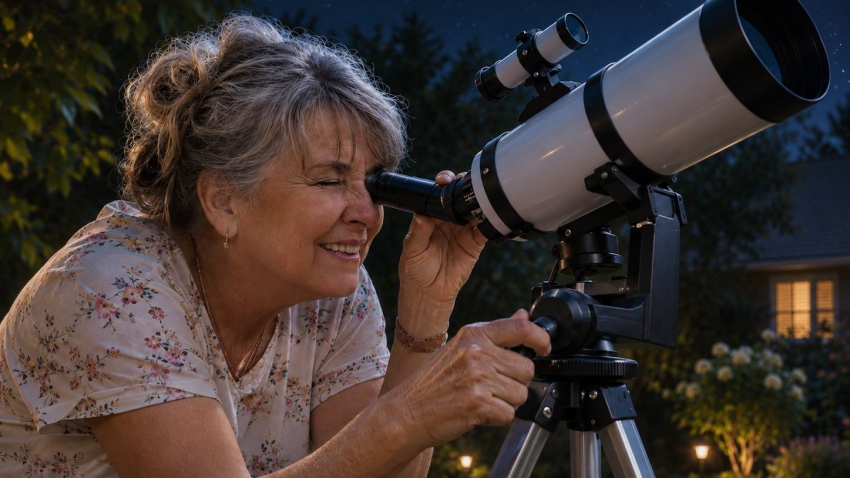
Getting into Amateur Astronomy in Retirement
Retirement is the perfect time for hobbies. When you’re working full time, there are probably a lot of things that you’re interested in, but you might not have time to do those thins. Once you leave the workforce, hours open up each and every day.
For some people, that means getting back into hobbies they once loved but didn’t have time for while they were working. For others, it often means picking up new hobbies. One hobby that you may not have considered is amateur astronomy.
Why Amateur Astronomy
The main reason why a lot of people choose to get into amateur astronomy is simple: space is fascinating. Since as far back as humans can remember, people have been interested in the sky. Even ancient people tracked planets and stars.
It’s also a hobby that doesn’t require any specific strengths, skills, or experience. It can be hard to get into a new hobby at any age, especially if you’re a senior in retirement. Sometimes there’s a steep learning curve or it’s overwhelming for a newcomer to try to “catch up” with those who have been involved for their entire lives. Astronomy isn’t like that. Every person who has ever started with amateur astronomy has started by looking up at the sky and curiosity.
Astronomy is one of the rare hobbies where amateurs can make actual research contributions. After all, not only is space beautiful and fascinating, it’s also incredibly large. It’s actually too large for even dedicated professional observatories to fully explaining on their own. If you are dedicated enough, spend enough time, and care about your work, it’s entirely possible to make a meaningful contribution to science. There are even websites like Zooniverse that build communities around helping to advance knowledge and research.
A lot of retirees find themselves lacking purpose when they leave the workforce. Dedicating some of your time towards assisting with research can give you a great sense of pride as well as the feeling of belonging to a dedicated community.
Amateur astronomy is also a peaceful hobby. No matter your age or physical state, there are often moments of quiet contemplation and peaceful feelings that give your mind the opportunity to relax and stretch itself. This is why a lot of people who worked stressful jobs their entire lives choose astronomy.
You Don’t Need to Buy Everything
When someone starts a new hobby, it’s common to run out and buy absolutely everything associated with the hobby right away. However, not only does this cost a lot of money, but you probably also aren’t exactly sure what you need if you’re just starting out. It’s often better to spend some time learning about the hobby, figuring out what you enjoy about it, and then making informed purchases based on your needs.
For instance, if you’re getting into astronomy, your first thought might be that you need to buy a telescope. This isn’t always the best place to start, though. Telescopes tend to cost quite a lot and they’re actually pretty difficult to use.
A great way to start learning about the night sky is to use nothing but your eyes. Yes, it counts as astronomy if you’re using the naked eye. Don’t fall into the trap of believing that you need to have the latest and greatest tools to consider yourself an “actual” amateur astronomer.
The first step is to get outside at night and just look at the sky. Even in a busy city, you should still be able to see some bright star clusters as well as planets like Mars, Jupiter, Venus, or Saturn (when they’re visible from earth). It often helps to move away from bright lights if possible. For instance, you’ll have a better chance seeing objects in the sky if you’re in a park away from streetlights.
It helps to have a smartphone application that gives you info on what is currently visible from your location and where to look. There are many out there, so try them out and see which ones work best for you.
Binoculars are often a good step before you move onto a telescope. Good binoculars will help you see planets like Uranus and Neptune as well as the moon’s craters up close.
After you’ve spent more time with astronomy and learned what you like about it and what you would like to explore, you may want to buy a telescope. At this point in your astronomy journey, you’ll have a better idea of what matters. It’s typically good advice to start with a smaller telescope at first, since it will be easier to carry and operate. You can then start researching larger telescopes as you get more serious about the hobby.
Finding a Remote Observatory
If you want to really get into amateur astronomy, you may want to investigate accessing a remote observatory. These facilities are equipped with telescopes, cameras, and other tools which can be controlled over the internet. You’ll be able to log in remotely to track objects in space, take photos, and observe. You can often schedule time to capture your own data and images or download data and imagery that have already been captured so you can conduct research.
Costs and accessibility will depend on the facility.
Building a Backyard Observatory
A step up from heading out with binoculars or a telescope is building your own backyard observatory. This can be a place where you can store your equipment and photography set up, protecting it from the elements and giving you access to a calm and protected place to observe.
Before you build anything, be sure to check into local zoning laws. You may be required to have building permits and receive permission from your homeowner association or municipality.
Most backyard observatories feature roll-off roofs, but a dome is a common shape as well. Once you’ve chosen the roof design, you need to plan the size and location. In most places in North America, you’ll want to position your observatory so you have clear visibility of the southern sky. You’ll also want to stay clean of porch lights and streetlights, as well as heat sources (since warm air can distort imagery).
If you want a more temporary or portable solution, there are soft-sided observatory tents.
Astrophotography
Once you start learning the night sky, you may want to get into photography next. However, if you’ve ever tried to take a photo of the moon or the stars, you’ve probably notice that it’s easier said than done.
The best way to improve your photos is to prevent camera motion. You’ll probably want to use longer exposures to take photos, so make sure you have a sturdy tripod. A remote shutter can also help, since touching the camera often causes vibration.
You’ll want to choose a camera that has a wide aperture and focal length. This can help you fit more into your frame.
It can help to shoot during moon phases where illumination is low. For instance, shooting during a new moon is optimal since the moon will be generally invisible at this point. Find an app that allows you to track moon phases and find dark locations and time periods.
Experiment with different camera settings to find the right ones that let in light during dark conditions. Shooting with a high ISO and long shutter speed will help you capture images. However, balancing the settings will improve the quality of your photos. Through trial and error, you’ll be able to capture enough light without bringing in too much grain or noise.There are so many aspects of amateur astronomy to enjoy, and the hobby is really what you make of it. Some people have a great time just sitting in a park looking at the stars, while others will focus more on scientific discoveries or epic imagery. Take whatever aspects of astronomy you like best and enjoy yo